





Canterbury to Brittany: A Rail, Ferry and Bus Adventure
INDEX Digital’s Stephen Gurney heads on a trip from Canterbury to Brittany (and back) by train, ferry and bus: avoiding planes, avoiding Paris.
Images INDEX Digital
Kent to the coast: the slow green start
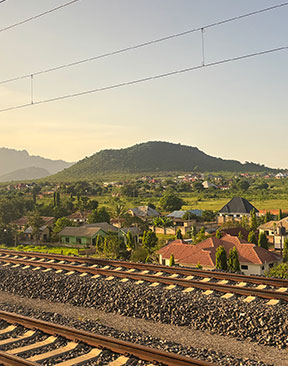
My journey from Canterbury, Kent to Brest in Brittany begins with a quirky three-carriage diesel train across the countryside to Eastbourne via Ashford. It’s a slow, charming cross-country route through Kentish green fields, where sheep and cows graze between hedgerows, interrupted by occasional ugly wind farms and the beautiful marshlands around Rye.
Somehow the people on this train feel different too – more colourful, more relaxed. Mind you, it is a Sunday. We stop at Rye before continuing through open countryside towards Eastbourne, then on to Newhaven for the ferry to Dieppe the next morning.
The track hugs the coast near Cooden, skirting marshland before finally pulling into Eastbourne. It’s a small, slightly forgotten line, but it has real character – exactly the kind of journey I was hoping for.

Newhaven and the ferry to France
I spend the night in a rough-around-the-edges Newhaven, a small port town that feels half asleep. A good roast at The Ship Inn in the centre, where everyone except me is glued to the football, rounds off the evening.
Early morning brings the DFDS ferry from Newhaven to Dieppe – a four- to five-hour crossing. I’ve got a small cabin, which turns out to be a luxury. There’s just enough time for a big breakfast, a wander around the ship and then an exhausted collapse for a nap.

Normandy: Dieppe, Rouen and Caen
Dieppe is surprisingly pretty for a port town. The port area is, as expected, basic and industrial. It’s full of British cyclists heading off the ferry into northern France or following the London to Paris cycle route. I’d assumed bikes on French trains would be complicated, but two friendly cyclists, Chris and Dave, assure me it’s far easier than expected.
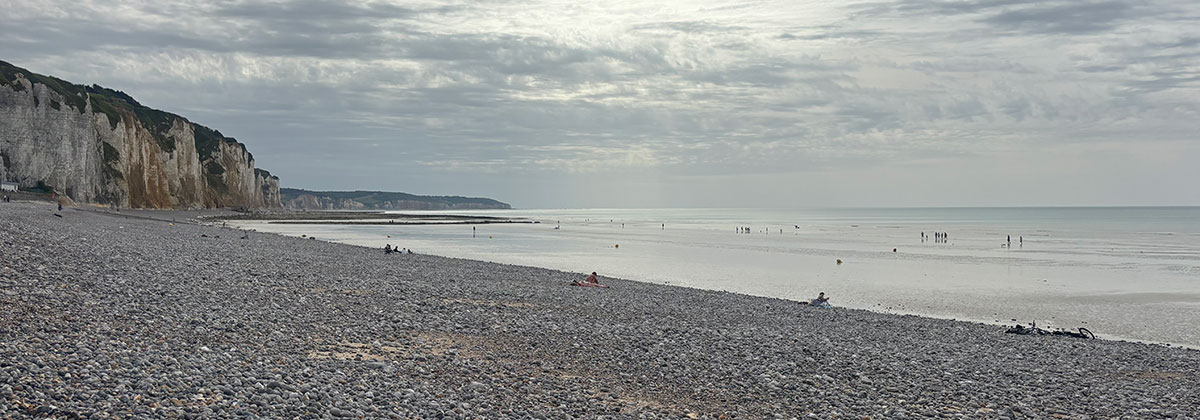
Dieppe town (a 10-minute bus ride from the port) felt like a soft landing into France, a faded elegance around the edges. Fishing boats sit alongside pebble beaches and seaside cafés, it has character, beautiful half-timber buildings and cafe culture – a real sense of everyday French coastal life unfolding.
I spent one night in Dieppe and then from here, I move quickly to get some way into my trip – a fast train to Rouen, then an afternoon FlixBus to Caen.
Rouen, the capital of Normandy, is known as the “city of a hundred spires”, many of which were painted by Monet. It’s a medieval city on the River Seine, full of beautiful churches, timbered streets and atmosphere.
The bus to Caen is less romantic – I’m crammed into the back seat for two hours and can barely move – but it gets me there.
Caen is a historic port city made famous by William the Conqueror, who built the vast Château de Caen in 1060, one of the largest medieval fortresses in Europe. It also carries deep World War II and D-Day history. The old quarter, Le Vaugueux, is full of half-timbered houses, cobbled streets, bars and restaurants – and it’s very walkable.
Into Brittany: Rennes and first impressions
From Caen I take an OUIGO train into Brittany. I actually get off one stop early by mistake and only realise as the train pulls away. Luckily the suburb is on the same metro line as my accommodation, so I continue easily using contactless payment at the gate.
Rennes feels like a gentle introduction to Brittany – half-timbered streets, lively squares and a balance between history and student energy. I wander through the old town beneath leaning facades, stop for coffee, then follow the river paths.
Known as “Little Britain”, Brittany owes its name to waves of Britons who crossed the Channel from Cornwall and western Britain during the early medieval period. Their legacy survives in Breton culture, music and language, creating a Celtic bond that still links Brittany with Cornwall, Wales and Ireland today. The region of Cornouaille (French) – Kernev in Breton – still carries echoes of that shared past.

Quimper, Concarneau and the Breton coast
The train from Rennes to Quimper is meant to be an iconic Brittany journey, though it doesn’t quite match expectations. One passenger insists on putting his feet up on the seat and pulling the blind down halfway, leading to an awkward compromise. I spend much of the trip bending down to catch glimpses of the scenery – which I’d describe as Cornwall-like, though not quite as dramatic as I’d imagined.
Quimper itself feels like a Breton storybook. Narrow lanes, half-timbered houses and the twin spires of Saint-Corentin Cathedral define the town. I wander along the Odet River, cross flower-decked bridges and linger in quiet squares. It has charm in the details rather than grandeur – slow, local, unforced.
From Quimper I take a short bus to Concarneau. The walled Ville Close sits like a stone ship in the harbour, surrounded by fishing boats and sea air. It feels maritime and lived-in, with an easy friendliness. There’s even a sense that Parisians and expats come here to retire – a kind of seaside utopia, almost film-like in its calm.
Crozon, Morlaix and the wild edge of Brittany
A couple of buses north bring me to the Crozon Peninsula. It feels remote in the best way – cliff-top paths, sweeping bays, hidden coves and Atlantic headlands shaped by wind and sea. My Airbnb has wide views over the peninsula, and everything slows down here.
Although Brest is technically my original destination, I continue past it and take the excellent 30-minute train to Morlaix instead. Morlaix is striking – a town built around a deep estuary and dominated by a huge viaduct. Steep streets, timber-framed houses, stairways and quiet squares give it a strong Breton identity.
From here I head to the coast again: a hot night in Morlaix followed by a cooler trip to the Roscoff peninsula.
A stop in Saint-Pol-de-Léon reveals a historic coastal town with a striking Gothic cathedral, narrow streets and windswept white sand beaches. From there it’s a final short bus ride to Roscoff.

Roscoff and the ferry home
Roscoff is a small port town but well worth a stop. It’s pretty, relaxed and famous for Breton crêpes – and for the story of the “Onion Johnnies”, Breton farmers who cycled across the Channel selling pink onions in Britain. There’s even a small museum dedicated to them.
From Roscoff I take the ferry to Plymouth – arguably the most sociable part of the whole trip. I meet a composer and her mother, a couple of Mediterranean sailors and a French music teacher called Roland, who is still bitter about Brexit and the extra bureaucracy involved in visiting the UK. He says it’s put many people off travelling between France and Britain, which feels like a real shame given the deep Celtic links between Brittany and Cornwall.

YOU MIGHT ALSO LIKE: The UK’s Most Scenic and Iconic Ferry Routes
Homeward
After a night in Plymouth (also slightly rough around the edges), I take the train back to Ashford – a final three-hour stretch home. I leave with good memories of Brittany and a quiet sense I’ll be back.
The whole journey proves how easy and effective it is to travel through France and Brittany without flying. Trains, buses and ferries all connect smoothly, and while a car might help in remote areas, public transport works remarkably well overall.
Cost
- Total transport cost around £250 per person.
- Accommodation averaged £75 per night.
- Ferries (Newhaven-Dieppe with DFDS) were about £35 each way, foot passenger, including a welcome cabin on the outbound crossing compliments of DFDS Ferries.
My favourites
- Food: The famous Breton crêpe is a paper-thin pastry from Brittany, France. In authentic Breton tradition, the savoury version is made with buckwheat flour and called a galette, while the classic sweet version uses wheat flour and is filled with melted butter, jams or sugar.
- Stay: In Airbnbs to meet locals.
- Rent: Electric bikes for the beaches
- Favourite Town: Quimper
- Favourite areas so far: Crozon peninsula and the Roscoff area
• This trip was provided courtesy of Discover Ferries
#BrittanyByFerry #DiscoverFerries #IndexDigital