


Four New Grotesques Unveiled at Canterbury Cathedral
Have you noticed who has been watching from Canterbury Cathedral?
Years in the making, four new grotesques have been silently watching from up high at Canterbury Cathedral.
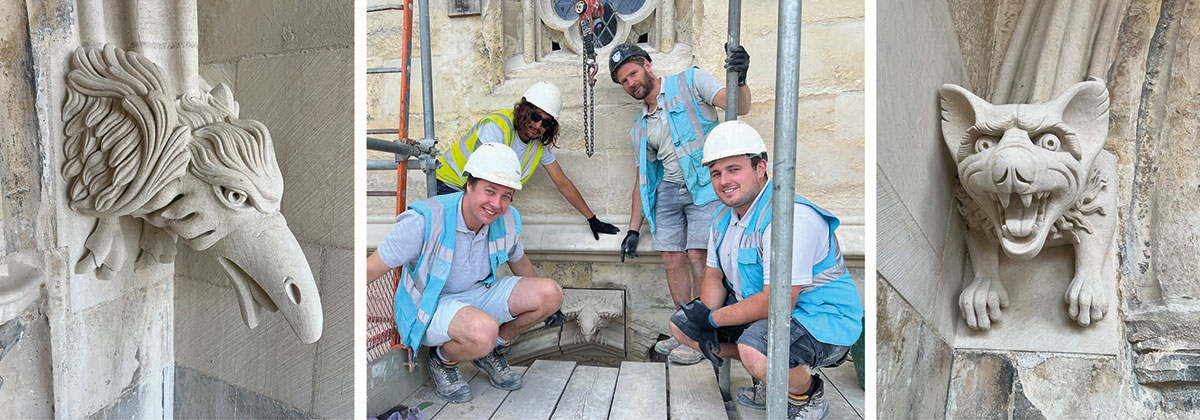
And after a few months to allow the stone creatures to get used to their habitat, a new in-depth video made in collaboration with Wildwood Trust has been released detailing the efforts of the stonemason team and revealing for the first time every claw, beak and feather of the four new grotesques.
Visitors may have noticed the scaffolding that came down in April this year, but what they probably did not realise is what a rare mission had just been undertaken. The stonemason team are usually concerned with restoration and preservation, but since 2022 they have been working on four unique and entirely new additions to the cathedral façade, as part of the West Front Project.
After it was found that several stone carving grotesques on the North West and South West Towers were so decayed they needed to be replaced, Benn Swinfield and his team got to work.

Crucially, because hundreds of years of weathering had made it impossible to tell what the original creatures had been, Dean David Montieth had the idea to look back to the past in determining what the future could be.
Added to the fabric of the building and brought to life by the stonemasons through traditional techniques and expertise, visitors to the Cathedral have recently been passing under the watchful gaze of four wildlife creatures that are either extinct or have been recently re-introduced to the Kentish countryside; a beaver, a peregrine falcon, a pine marten and a chough.
Beavers were recorded in Canterbury since the 5th century, and very recently have been re-introduced to the river Stour. The Cathedral itself now has two resident peregrines. And Choughs – woven into the legend of Sir Thomas Becket as it is said a crow transformed into one after coming in contact with the martyr’s blood – can now be seen in the Kentish skies after 200 years.
Currently the pine marten is still absent from the county, although Wildwood Trust, Kent Wildlife Trust and partners are working hard to see their return. For now, the exquisitely detailed stone carving is the only sighting of this incredible creature, to the left above the Great West Door.
The new grotesques act as important reminders to help support and protect the rich biodiversity of the area, especially during the celebration of Creationtide (1st September to 4th October) when Christians are called to celebrate God as Creator and renew humanity’s responsibility to care for the Earth we all share.
And the video released from Wildwood Trust goes into detail about the design of the grotesques; the modelling, carving and casting, and finally its installation.
It also shows how the organisation is helping re-introduce these rare species back into the ecosystem through the award-winning partnership between itself and Kent Wildlife Trust, which has led to some of the UK’s most ambitious and groundbreaking species recovery projects. Together, the charities have reintroduced beavers at Ham Fen, spearheaded the return of the red-billed chough to Kent and, alongside other conservation partners, are carrying out feasibility work to explore the potential reintroduction of pine martens to the South East.
The new grotesques show how Canterbury Cathedral acts as a living monument to history, spirituality and community: preserving the past through centuries-old skills and highlighting the living creatures that share the space around the stone.
Stone doesn’t last forever. Wind, rain, frost and most recently atmospheric pollution are the challenges it faces. But with the stonemason team at Canterbury carefully maintaining every stone brick, grotesque and gargoyle – the Cathedral should be in great shape for future generations to come.
YOU MIGHT ALSO LIKE: Canterbury Adventures in 2026: History, Culture and Celebrations
Likewise, we cannot take for granted the wildlife that shares our planet, which is why the work of Wildwood Trust and Kent Wildlife Trust is so important. They will continue to build on previous successes, from last year’s introduction of red choughs following decades of work to restore and manage vital chalk grassland, to the ongoing efforts to make pine martens a common sight in the Garden of England once again.
Dean David Monteith, Dean of Canterbury, says: “I was a biologist originally when I went to university, and so I have a great love for nature. When I came to Kent, I was learning about the work of reintroducing historically native animals to the county, and so I wondered if we could capture some of these beautiful creatures in stone.
“I think all of us realise that we have to be responsible in the way that we live if we are to enjoy our life as much as we can, which includes caring not just other human beings, but every single creature. Part of my vision is to encourage people to be generous in supporting wider efforts to do that but also think about what they could do for themselves.”
Benn Swinfield, Senior Stonemason, said: “When you look up at the building, there is a very distinct theme of animals and creatures, and we thought why not take this as an opportunity to illustrate how important it is to save those that are native to Kent.
“Our generation is the next link in the chain, passing skills from master to apprentice, and so on. We are responsible, not only for maintaining the building, but maintaining the centuries-old craft of stonemasonry – because once the skills are lost, they’re lost. So, I think it’s really important that here at the Cathedral we are continuing the craft and these traditions.”
Paul Whitfield, Director General Wildwood Trust said: “We are thrilled to see native species represented in the grotesques of Canterbury Cathedral, a UNESCO World Heritage Site. We hope these remarkable additions will inspire visitors from around the world to connect with Britain’s wildlife and actively support its recovery.”
A second video from the Cathedral and the Wildwood Trust focusing on the heritage of the Chough and their place within Kentish folklore will be released at the end of the month.
#VisitCanterbury #KentDaysOut #CanterburyCathedral #IndexDigital