





A Weekend In Delightful Deal
The enchanting town of Deal – nestled on the coastline of the English Channel in ‘England’s garden’, the fragrant county of Kent – has lots to offer all on a day out or weekend away.
By travel journalist Rebecca Underwood
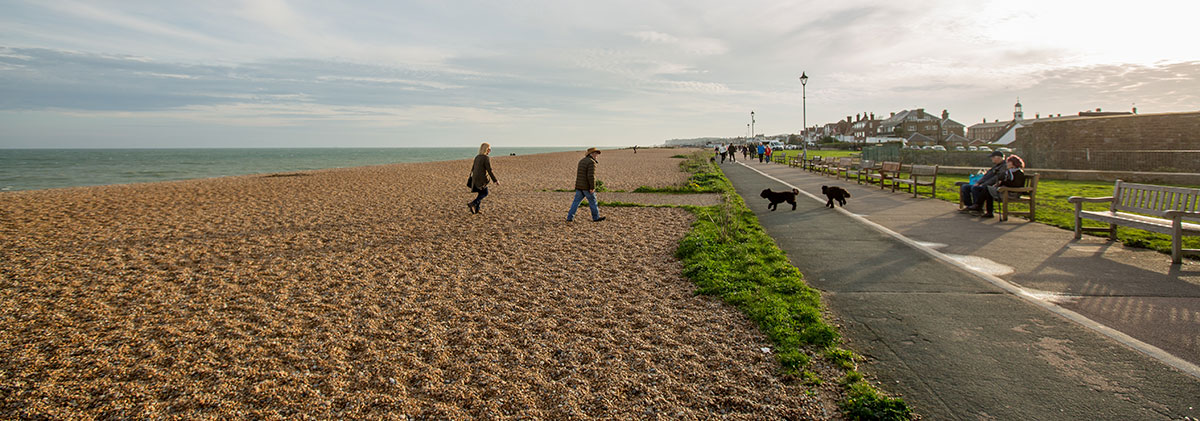
Top Image A stroll along the promenade, courtesy Visit Kent
Due to an abundance of independent local retailers and a friendly ‘village’ feel, Deal retains its appeal. The town’s motto is ‘Befriend a Stranger’ and I was keen to experience a little of that Kentish charm and to take a glimpse into its rich maritime history.
In 1278 the federation of Cinque Ports was formed with the objective of uniting the ports of Dover, Hastings, New Romney, Hythe and Sandwich militarily and to simplify trade. With no harbour, Deal was considered a ‘limb port’ for Sandwich but it soon became the busiest ‘port’ in England.
Deal’s coastal waters, known as the Downs, offer a natural sheltered anchorage area for vessels seeking refuge and the little town became a strategic ‘port’ for the Royal Navy and merchant vessels. Although the French coast is only 25 miles from the town, Deal’s shoreline is close to the treacherous 12-mile-long Goodwin Sands; graveyard to many unfortunate ships.
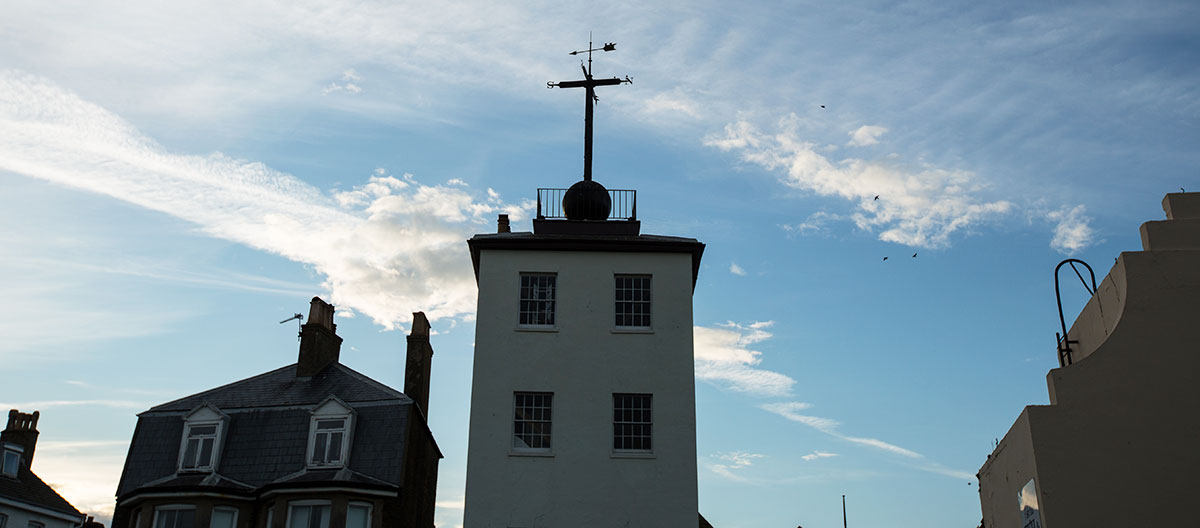
Image Deal Timeball Tower, courtesy Visit Kent
First on my list was a visit to the Deal Timeball Tower, which is a museum housed in a four-storey building, established in 1855 and located on Victoria Parade. A Victorian maritime GMT signal, known as a timeball, is installed on the roof of the building, and the ball, responding to a signal transmitted by the Royal Observatory at Greenwich, dropped daily at 13.00 hours, enabling navigators to confirm the setting on their vessel’s marine chronometer, which then determined longitude by way of celestial navigation. The museum’s exhibits include part of the first cross channel telegraph cable and a collection of model boats including HMS Victory. In 1805 news of Britain’s greatest naval victory at the battle of Trafalgar and the death of Nelson was transmitted from Deal to Admiralty House in central London.

After a visit to the museum, a leisurely stroll along the seafront is just the ticket for us landlubbers in search of some hearty ‘scran’. The Lane, a very popular restaurant located nearby on South Court, serves an extensive choice of tempting treats including a delicious fish finger sandwich. And for those of us with a sweet tooth, the biscoff cheesecake is simply unforgettable.
Another popular spot for visitors is Deal’s Maritime and Local History Museum on St George’s Road. Exhibits include the only known pair of carved spar boards, taken from a vessel once owned by one of Deal’s most notable residents; Jock Willis, the owner of the Cutty Sark. Also on display, is an intriguing collection of old life jackets, which hangs from the ceiling, an extensive collection of Royal Marine memorabilia, and there are cases containing beach combings, coins, clay pipes and artefacts galore including whale bone vertebrae, which would have been sent to Sheffield and London to be used in the cutlery trade.
I wandered around the stables gallery, which is housed in a building dating back to the 18th century and is known to have held 40 mules and two horses used to transport armaments during WWI. I took a stroll around the boat yard and viewed the Penny Ann (previously called Secret); a Deal Beach Boat, and the Montague Whaler, which was used by the Royal Marines and the Deal Sea Scouts.

Image Local vessels, courtesy Visit Kent
Also on view is the Saxon King, a smuggling galley built in 1891. Deal, of course, has a long history of attracting smugglers and in the late 1700s Prime Minister William Pitt the Younger dispatched a company of soldiers to deter them. Due to a severe storm, the smuggler’s boats were lined up on the shore and the soldiers promptly smashed them to pieces and then burned them to cinders, but the plot failed as it was a very lucrative business and the boats were quickly replaced. Another notable event took place on 12th July 1771 when Endeavour anchored in Deal’s waters and Lieutenant James Cook and his crew, on their return voyage to Australia and New Zealand, stepped ashore in England for the first time in nearly three years.
During the 19th century, in the age of steam ships, Deal’s prosperity began to decline but it rapidly improved during the Victorian era of tourism when Deal’s railway station opened in 1847 to much fanfare and it is said that Charles Dickens attended the celebrations.

Image Deal Pier, courtesy Visit Kent
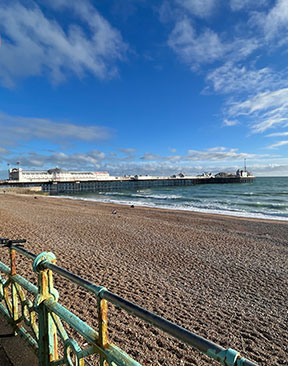
The first wooden pier was built 10 years later and visitors flocked to the town. Today’s pier, a Grade II listed building, was opened in 1957 by HRH the Duke of Edinburgh and it is 311 metres in length with a three tiered pier head and provides a great spot for fishing.
Next on my list was a visit to Deal Castle, built at the behest of King Henry VIII between 1539 and 1540, also attracts the crowds. This imposing artillery, located on Deal’s beach front, served as a fortress in defending against the risk of attack following the coalition of the French King, François I, and Charles I of Spain. One of the most impressive Tudor castles in England, it really is a spectacular sight and visitors are welcome to explore the many passages that meander through the enormous bastions and admire the Caen stone and rag stone brick taken from local religious buildings following the Dissolution of the Monasteries, and of course the moat, which is 20 metres in width with a five-metre depth.

Image Deal Castle, courtesy Visit Kent
For weary travellers seeking high levels of comfort and service, The Royal Hotel, located on Beach Street, is within a stone’s throw to the town centre and it’s the place to stay. Originally named the King’s Arms and then renamed the Three Kings in 1699; it is an impressive quirky property, which, during the 18th century, was once used as a courtroom where the defendants were often local smugglers apprehended with contraband.
In the summer months of 1801, Napoleon Bonaparte was assembling an invasion fleet off the coast of France and Vice Admiral Lord Nelson was dispatched by the Admiralty to assess the situation. Nelson’s ship, HMS Medusa, arrived in Deal on 29th July and he reserved a suite at the Three Kings where he hatched a plan to tow the French ships away from their moorings and destroy them. However, the plan failed as Napoleon’s ships were chained together and Nelson subsequently lost many men including his protégé, Captain Edward Thornbridge Parker, who was buried in St George’s churchyard, opposite Deal’s Maritime and Local History Museum, which contains the bier that his casket was carried on.
Nelson sent a letter to his friends Sir William Hamilton and his wife, Lady Emma Hamilton, inviting them to visit Deal and to comfort the injured sailors; they promptly reserved a suite of rooms at the Three Kings and extended their stay.

Image The Royal Hotel, Deal, Kent
Sir William indulged his passion for fishing and Lady Hamilton explored the Kent countryside by carriage, escorted by Nelson. The biggest scandal of that time was about to erupt and the affair between Lord Horatio Nelson and his mistress Lady Emma Hamilton provided much tittle-tattle for ladies gathering in parlours.
The Three Kings was completely refurbished in 1837 and renamed The Royal Hotel in honour of Queen Victoria who ascended the throne on 20th June in the same year.
YOU MIGHT ALSO LIKE: Folkestone Awaits: Where Diversity Meets Coastal Charm
The hotel’s rooms are spacious with contemporary furnishings in light, subtle hues, soft carpeting and comfortable beds and the theme throughout the property reflects the area’s rich maritime history. I opted to stay in the elegant Nelson room, which features a roll top bath, within the room, right next to a wide window affording sweeping views across the briny. I took advantage of the furnished balcony and after a comfortable slumber I took in some deep breaths of salty air, whilst sipping on my piping hot coffee and I was ready for a morning stroll along the promenade.
For an excellent luncheon experience I returned to The Royal Hotel’s Quarterdeck restaurant and I ordered the succulent Whitstable Bay battered haddock and chips, accompanied by a chilled glass of Pinot Grigio. My order was served with aplomb and after a long period of relaxation it was time to explore further.

Image A resident of Port Lympne, courtesy David Rolfee
I made my way to the Port Lympne Reserve, which offers a fun day out for all the family and it is only 25 miles from Deal. The reserve, which focuses on conservation, covers 600 acres and is home to more than 700 rare and endangered animals including lions, tigers, cheetahs, lynx, red panda, buffalo and western lowland gorillas. I hopped onto the safari bus and viewed zebra, black rhino, ostrich and giraffe, free to roam over 100 acres. Another attraction, which is very popular for the ‘little ones’ is the dinosaur forest, which features more than 100 anatomically correct and life-sized models, including the Pterodactyl, Diplodocus and T Rex.
Whatever you decide to do in Deal, it is sure to be a delightful experience.
Top tip: Let the train take the strain, avoid traffic delays and parking problems. The South Eastern train service from London St Pancras to Deal is only 1 hour 45 mins. For more information visit southeasternrailway.co.uk
#VisitKent #TravelInspiration2025 #DaysOutInKent #VisitDeal #IndexDigital