



A Finnish Adventure by Rail and Bus
Index Digital’s Stephen Gurney discovered the delights of Finland as he explored this beautiful country by bus and train heading up to Lapland before looping back south.
Images Index Digital
Tallinn, Estonia – A Medieval Jewel with a Dark Past
The starting point for my latest adventure was in Estonia’s capital Tallinn. It is the capital of Estonia (just a 2.5-hour flight from London) and has a rich and complicated history. Located only 50 miles south of Helsinki and 200 miles west of St. Petersburg, it has been settled for around 5,000 years and today has a population of about half a million.
Over the centuries, Tallinn has been ruled by Denmark, Germany and Russia. Both Germany and Russia heavily bombed the city during the Second World War, leaving deep scars. In the Old Town, the KGB prison cells now serve as a grim reminder of the brutality faced by political prisoners during Soviet occupation. Estonia finally regained independence in 1991, when Boris Yeltsin was president of Russia, and to this day Estonians remain understandably wary of their giant neighbour.
Despite its turbulent history, Tallinn’s UNESCO-listed Old Town is one of the best-preserved medieval city centres in Europe. Its cobbled 13th century streets, merchant houses and fortress walls make it both touristy and stunning.
Top tip: Take a free walking tour – an easy way to learn the layered history of this small but fascinating capital.

Helsinki – Nordic Design and Baltic Charm
From Tallinn I hopped on a ferry crossing to Helsinki in Finland. The two-hour ferry costs around €25 and is as much a party as a crossing, with live music and groups of Finns returning home after weekends of cheap beer in Estonia.
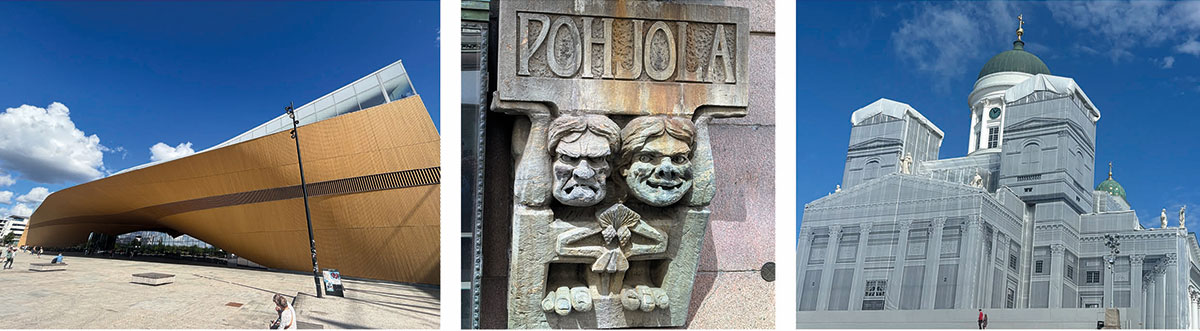
Helsinki, Finland’s capital, sits on the Gulf of Finland and has a population of around 690,000. The city has a distinctly cosmopolitan Scandinavian feel, with wide boulevards, grand buildings and vibrant café culture.

Helsinki was officially founded in 1550 by King Gustav I of Sweden. The city endured centuries of conflict, including Swedish and Russian occupations, devastating fires, and the plague of 1710 which wiped out most of the population. Russian rule in the 19th century left a clear architectural mark, while Swedish heritage lives on in language – today about 5% of residents are Swedish-speaking.
Finland’s reputation for world-class design is everywhere in Helsinki. Architects such as Lars Sonck helped shape the city, with landmarks like the Mikael Agricola Church (1933-35).
Despite being labelled the “happiest nation in the world,” Finland also has one of the highest suicide rates – something even the locals joke about. Still, Helsinki feels relaxed, welcoming and exceptionally safe. Public transport is flawless: trams, buses and the metro are all tap-and-go with a credit card.
Oulu – Gateway to the North
From Helsinki I took an eight-hour bus north to Oulu, a city of around 216,000 on the Gulf of Bothnia. Oulu will be the European Capital of Culture in 2026, and much of the city is being revitalised in anticipation.
Founded in 1605 by King Charles IX of Sweden, Oulu grew as a trading port and later became an industrial hub. Today it is best known as a centre for technology and innovation, often nicknamed Finland’s “Silicon Valley”.
The city feels spacious and airy, with a cycle-friendly vibe reminiscent of Copenhagen. Bridges link leafy islands, air quality is superb, and there’s a strong connection to nature. A swim in the river is a must, and the Pikisaari area with its free electric saunas and riverside cafés is a highlight.

Rovaniemi – On the Edge of Lapland
My plan was to take the train from Oulu to Rovaniemi, often listed as one of Finland’s most scenic rail journeys. Instead, engineering works meant a replacement bus – and sadly no northern lights.
Rovaniemi, with a population of around 63,000, was 90% destroyed by retreating German troops in 1944. It was later rebuilt to designs by Finnish architect Alvar Aalto, which explains its modern, somewhat concrete feel. Despite this, Rovaniemi is considered the gateway to Lapland and a hub for Arctic adventures. Just outside town lies Santa Claus Village, a popular attraction where jobs as “elves” are advertised year-round.
The three-hour bus ride here passes through vast forests, shimmering lakes and scattered wooden houses – reminders that Finland has an estimated 10 trees for every person on Earth.

Kokkola – Wooden Houses and Coastal Beauty
From Rovaniemi, I took a 2.5-hour train south to Kokkola, a small town of about 48,500 on the Gulf of Bothnia. Founded in 1620 by King Gustav II Adolf of Sweden, Kokkola grew as a shipbuilding and tar-exporting centre. Its old wooden quarter, Neristan, is one of the best-preserved historic districts in Finland.
Renting a bike here is the best way to explore the coastal peninsulas, with their stunning views and some featuring pretty wooden seaside homes. Unlike other stops, Kokkola feels relatively untouched by mass tourism. Winters can plunge to -40°C while summers can reach 35°C – a striking contrast that shapes life here.
YOU MIGHT ALSO LIKE: Train to Spain: A Rail Odyssey Through France, Spain and Portugal
Tampere – The Sauna Capital
My first impression of Tampere wasn’t great – arriving in the middle of a hip-hop festival meant streets full of rowdy teenagers. But by the next morning, the city had completely transformed.
With around 250,000 residents, Tampere is Finland’s second-largest city. Founded in 1779 by Gustav III of Sweden, it developed rapidly in the 19th century as an industrial centre, powered by the rapids that flow between two great lakes: Näsijärvi and Pyhäjärvi.
Today Tampere is known as the “Sauna Capital of the World,” with over 50 public saunas. I tried the Rauhaniemi sauna, first opened in 1929, where locals chat, sweat and plunge into the chilly lake in a ritual that feels quintessentially Finnish.

Turku – Finland’s Oldest City
The intercity train from Tampere to Turku, Finland’s oldest city, took just under two hours through farmland and small wooden towns.
Turku, founded in the 13th century, was Finland’s capital until 1812 when Tsar Alexander I moved the seat of power to Helsinki. Some Turku residents still hold a grudge. The city also suffered a catastrophic fire in 1827 that destroyed 90% of its buildings. Despite this, its medieval cathedral and riverside aura give it a distinctive charm.
Locals swear that the best way to meet Finns is in the sauna. I tested this theory at Villa Järvelä Oy on Lake Littoistenjärvi, a wellness complex of wooden huts with five saunas, hot pools, ice baths and a jetty into the lake. Here I met Mikka, a local architectural historian, who explained that Finnish towns were laid out with wide grid-like streets to slow the spread of fires – though this didn’t save Turku in 1827.
Final Thoughts
Finland is one of the easiest and most enjoyable countries to travel around by public transport. The intercity trains glide like silk compared to the UK, and buses like FlixBus offer cheap, comfortable alternatives.
Highlights of my trip:
- Best vibe: Oulu (north) and Turku (south)
- Best city: Helsinki
- Best experience: Public saunas, food and Finnish people
- Most touristy but charming: Tallinn
- Best food: Viking dinner in Turku
- Best hotel: Nunne Boutique Tallin
• A flight from London costs approximately £200
• Travel by train and bus: £180 in total
#RailTravel #VisitFinland #FinlandByTrain #TravelInspiration #IndexDigital