





My Experience of Independent Travel Around Tanzania
INDEX Digital’s Stephen Gurney explores Tanzania by train and boat to discover the wonderful sights and culture of this East African country on his latest travels.
Images Index Digital
 For my most recent travel adventure I decided it was time to head to Tanzania. The major city of Stone Town in Zanzibar was my first stop after a six-hour night flight from Oman via Dar es Salaam.
Stone Town was originally a tiny Swahili fishing village called Mji Mkongwe, until it was happened upon by Portuguese traders heading for India who had been blown off course in the 15th to late 16th century. It was then run as a colony and trading post by the Portuguese for ivory, spices and slaves.
Zanzibar was under Portuguese control for over 150 years – however, in the 16th century the Omani people, who were already in Zanzibar, worked together with the Swahili Africans to form an alliance to fight the Portuguese colonialists who were eventually thrown out by the ferocious Omani and Swahili fighters, including other tribes.

From 1698 to 1856 it became a Sultanate of Oman and the Omanis ended up with complete power by the 18th century – with Zanzibar becoming the capital of Oman – they called it Zinj el Barr (the land of black people). They built houses made of stone and land coral – hence the name Stone Town.
In the late 1890s Zanzibar came under the influence of first Germany and then the British who abolished slavery in Zanzibar and East Africa. The Swahili language was founded in Zanzibar as a mixture of different languages from traders from Persia, Oman, India and even China.
You can see the Omani influence in the buildings and the People’s Palace and the House of Wonders – the first three-story building with electricity on the island.

Stone Town is now a UNESCO heritage town with a population of 80,000. The doors here have a special significance in that each door has a family history and status of the people that built the houses.
The doors are carved from Indian wood and each carving represents different owners and countries including chains to indicate slavery and sharp points sticking out to stop elephants breaking down the doors (this comes from India when elephants were used to break into enemy homes).
I spent some time in the quite busy resorts of Nungwi in the north and Paje in the East. Both have beautiful beaches, but I slightly preferred Paje as it had more of a surf vibe – Paje gets quite windy and the tide goes out a long way though!

Nearly every East African overland trip or safari itinerary includes Zanzibar, so there are a lot of tourists in the peak season which runs from June to October.
Here you will enjoy the beautiful beaches but it’s a bit of a game of dodge the touristic Maasai warriors who are wanting something from you with the same phrase “hakuna matata” and “where are you from my friend” trying to engage you in conversation. If you respond you’re in and a bag of trinkets gets opened in front of you – escape is much harder.
The best ways to get around Zanzibar are by taxi, the Zanzibus (see the app which is very good) and dala dala (if you are feeling adventurous!). Locally Bajaj (tuk tuk) is great – but check prices first – and even riding on the back of a motorbike (Boda boda) is cheap – but you take your life in your hands!
There are some beautiful less touristy areas like Jambiani or Michamvi on the east coast or Kizimkazi Mkunguni on the south coast.

The Ferry from Zanzibar to Dar es Salaam
This trip is an experience in itself! I headed to the ferry ticket office in the blazing heat to catch the next available ferry. I was immediately schmoozed by a guy with an official looking badge and taken to a back street agent. Initially it felt uncomfortable but the ticket price was the same and for the few quid I gave him he helped me to negotiate the crazy ferry terminal. I would say pre-book online and arrive one hour early though. Then if you get approached (and you will) just say you have a ticket.
The theme pretty much continues in Dar es Salaam, especially on foot. I was approached a lot, always with an ulterior motive to sell me something. Generally it’s easy to say a polite no thanks! I do like to walk around cities to get a proper look and feel – walking around the streets in the evening felt safe, the main danger being from broken pavements and fast traffic!
The options for getting around in Dar es Salaam are: Bolt (the best bet – you know what you’re paying, if they turn up!), taxi and tuk tuk (both require pre-agreeing the price ideally).
YOU MIGHT ALSO LIKE: A Finnish Adventure by Rail and Bus
Dar es Salaam City Centre by the port feels like a messy, crazy, bustling, hot city. I am going to do another piece soon on the art of travel – as soon as I understand it! I visited the National Museum, the fish market, the famous Gymkhana Club and I looked for the old block of flats where I lived when I was three years old.
I had wanted to arrange a safari at some point and someone around the port approached me. It was probably a bit silly, but I decided to accept and was then carted off to an ATM to pay him $260 – more of that fiasco to follow!
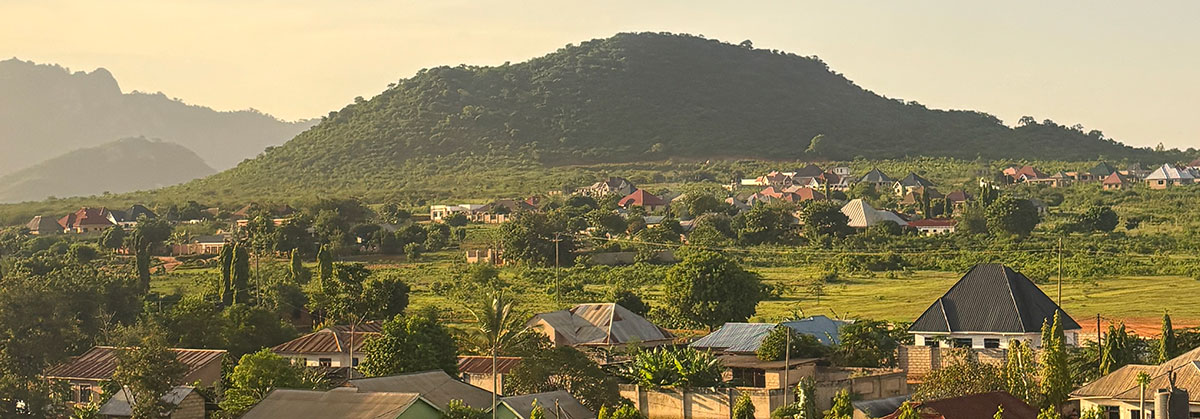
The first part of this trip from Zanzibar is to take the new electric train to Morogoro.

It was a very efficient fast train and takes two hours. There I met my safari contact from the port, Osman. He told me we were transferring to outside the Mikumi National Park. From that point followed taking a bajaj (tuk tuk), waiting in a field and then getting on the back of a motorbike (bouncing around) chasing what turned out to be a small local bus (dala dala). We then had a very uncomfortable four-hour journey to Mikumi.
By this point it was dark and I was feeling a bit ripped off. Luckily Osman was with me but unluckily for him I shared with him my frustration. He just said: “don’t worry hakuna matata” (the stock saying especially in the tourist areas). Eventually after a bouncy, hot and long journey we arrived at our accommodation by the entrance to Mikumi National Park. The Angel homestay was okay but I was the only person there.
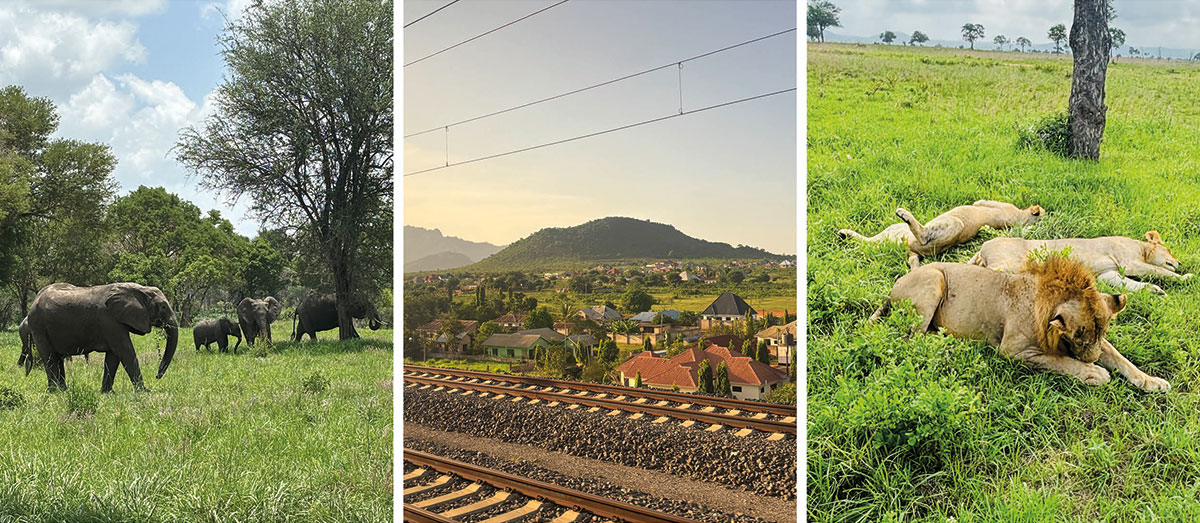
The next day after breakfast my smiley safari driver Abdulla turned up in his open Land Rover so I started to feel a bit reassured. I had been promised there were other guests on this trip who flew in from Zanzibar and we met at the airport within the Mikumi National Park. On the main road to the park we saw giraffes and elephants before the entrance which was great.
The safari itself was very good. At this time of year most animals are walking around with their young so we saw lions and their cubs, elephants and their babies and giraffes with young as well as many birds and antelopes. It did feel a bit like an open zoo as the animals were close to the entrance and completely unfazed by the many tourist jeeps.
Abdula explained that if you go further in the bush the animals stay away from the jeeps, so it is harder to see.
Overall, the day safari was very good and I had paid a reasonable amount in the end despite my reservations, still I think I would recommend booking through your hotel recognised tour operator unless you want to wing it.
In the afternoon, Osman, my calm helper, dropped me off at Mikumi bus station and amid all the chaos helped me into the correct bus. You do get hassled at the bus stations – it feels crazy but safe, and a polite no does the trick. Osman seemed to have a bit of a habit of underestimating bus journeys, so five hours later (he had told me two!) we arrived.
Some of my thoughts while on the bus included: ‘Right now I’m stuck on a bus on a hill going nowhere, I think I’ve messed up’ and ‘My days of this sort of travel are over’.
While stuck on the bus in a long traffic jam on way from Mikumi to Iringa 600 miles from Dar es Salaam near the Mikumi National Park I had the stress of not knowing if the bus was going to stop in Iringa or where and how do I get to my accommodation. I was also on the back seat of the bus and the driver had no concept or patience for the many speed bumps so every few minutes we would all be bounced up in the air!
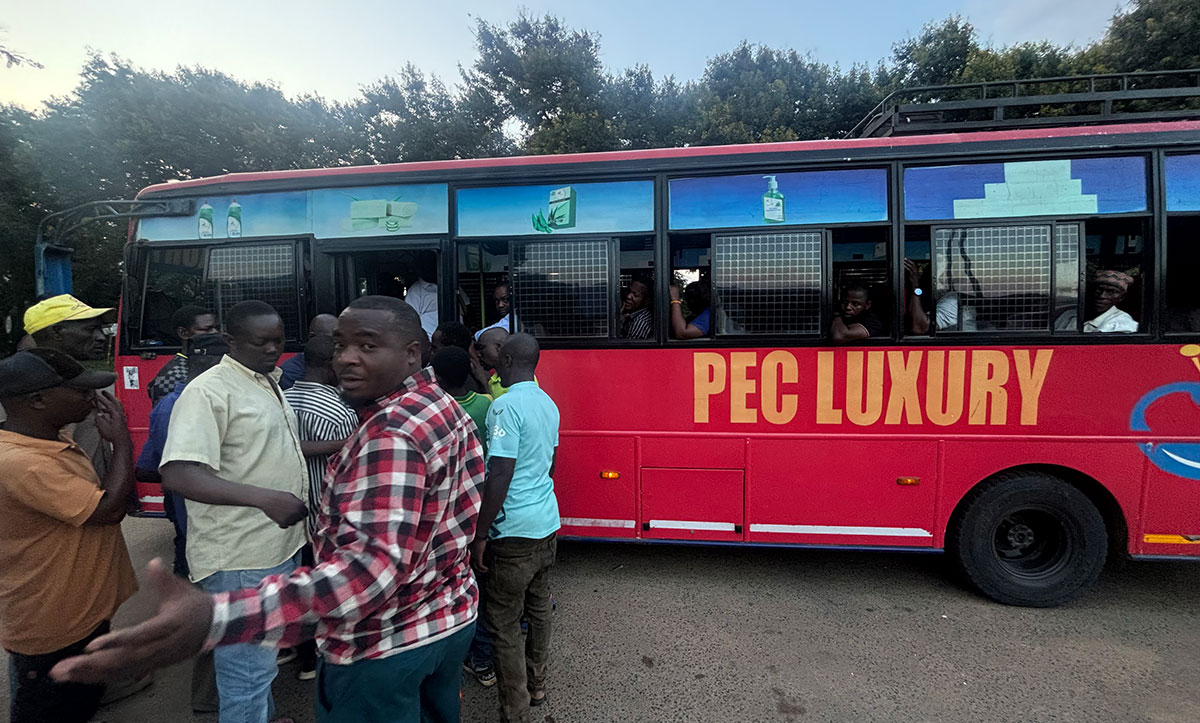
However, I did eventually find someone on the bus who spoke English who helped me meet my homestay host which was a relief because we stopped at a chaotic bus station four kilometres from Iringa late in the evening. I was planning to walk – but that, I think, that would have been a bad decision!
I arrived at my homestay tired and a bit broken. But one thing that stays in my mind is that someone will always help you and the people are kind and friendly.
So far I have travelled independently under my own steam on trains, dala dala and public buses in Tanzania. The train was good but the buses are challenging and chaotic and working out where they stop or are going is impossible. For most of it the travel help of kindly locals is needed as they understand the public bus system.
Still I have found a beautiful, cool bolt hole (Aika Sunrise homestay) in the hills of Iringa which is where I rested for a few days to recover.

Aika Sunrise homestay is run by Aika and her English husband Ian and two young kids. It is based in the hills above Iringa in a beautiful spot with lovely staff and a feeling of being part of the family. I had a great time there hanging around with the family and Opendo my waitress. I even had a lizard for company for the three days. This was a great chance to unwind before the continuation of my adventure.
So maybe in Africa the art of independent travel is regular stops to recover, especially with the roads and traffic, and allow people to help. Plus I would recommend researching the buses and ideally use luxury operators like BM or Kilimanjaro buses. I try to limit my travel to four hours a day if I can.
Iringa is a small city in Southern Central Tanzania approximately 600 kilometres inland from Dar es Salaam. It sits on a cliff at 1,500 metres above sea level overlooking the Ruaha River valley. Iringa was once a German colony in 1866. It is also the gateway to Rungwa Game Reserve (3,500sq miles) the biggest reserve in Tanzania and I am told one of the best (least touristy) parks to visit. The town itself has a commonwealth war memorial with mainly German graves from the first world war, a huge market and an impressive mosque. It has the coolest climate in Tanzania.
The Hehe people are the largest ethnic group living in the region, although it is popular with European visitors due to the cool climate and National Park. However I did not see many westerners at all. Overall, the town has a good feel to it.
Ian arranged a bus ticket for me to Dodoma (four hours) and even got his helper to get me to the bus stop and on the bus (this time luxury but African luxury which is a bit different to our luxury). Still four hours later we arrived in Tanzania’s capital city Dodoma. The bus and train stations are regularly outside of the city’s so you will need a bajaj (tuk tuk) or taxi to get to your hotel. Dodoma is the new capital of Tanzania and parliament centre. It has a population of 800,000 and had a good feel about it.
After a night at the comfortable Best Western hotel I took the electric train back to Dar es Salaam (four hours) and then a taxi (after some negotiation) to Bagamoyo one-and-a-half hours north along the coast.
Situated 75 kilometres north of Dar es Salam, the town of Bagamoyo sits on the coast of Tanzania coast pretty much opposite Zanzibar. Bagamoyo served as the major port for the delivery of ivory and slaves (often walked in chains from lake Tanganyika in East Africa) to be shipped to Zanzibar. Many slaves died on the arduous journey carrying the ivory and wood for their Arabic, German and latterly British slave traders, although this is disputed in some accounts. The main trade was ivory followed by slaves and spices. There are many historical Arab, German and British buildings here as well as a German burial ground from the 1890s.
Bagamoyo is also a major fishing centre with a thriving fish market by the port. The town has such a nice feel to it that I am stopping here for a week at the Firefly boutique lodge right in the middle of town and a fascinating 1890s building in itself.
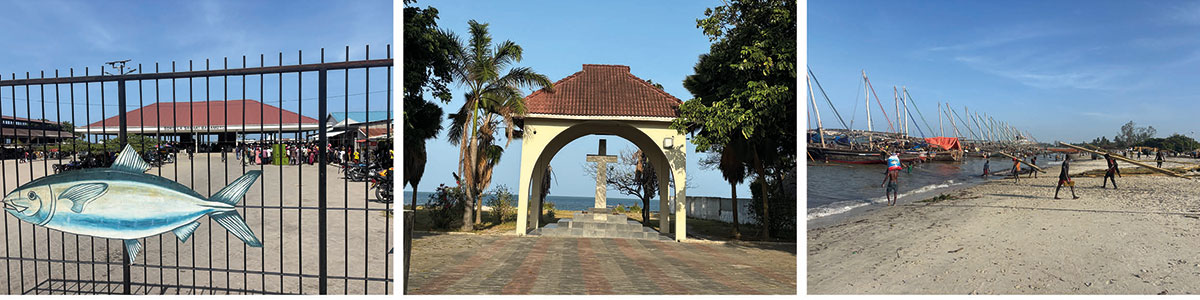
Bagamoyo is well worth a visit – it has a great history, very good beaches and a good local art and music scene. I really enjoyed walking around learning words in Swahili and chatting to local artists and cafe owners. It’s worth doing a cycling tour as well which I booked at the Old Slave market, a famous landmark and now an open craft market.
Next up was a seven-hour bus to Moshi in the foothills of Mount Kilimanjaro. While the bus journey was uneventful, some of the scenery was good and I had a great breakfast at Bagamoyo’s out of town bus station from some ladies cooking sardines, chapattis and sweet tea in a tin shack.

Moshi is the launch town for hikes to Mount Kilimanjaro and surrounding waterfalls. From Moshi you can climb Mount Kilimanjaro for 8-9 days with guides and porters. Moshi’s famous neighbour Arusha tends to be the launch point for safaris to the most famous Serengeti National Park and Ngorongoro Crater and National Park. Both are quite touristy I found. Mikumi National Park in the south seems to have fewer tourists but still flights from Zanzibar arriving there. My suggestion would be to take the new train from Dar es Salaam to Morogoro and then arrange your safari with your hotel.
I wanted to do the train from Moshi back to Dar es Salaam the next day so I found the train station and booked my ticket there for approximately £4. It’s really difficult to book online so the best bet is always to go to the station in person a few days before.
Now we are to set off on one of Tanzania’s original trains – a journey that should take 14 hours to Dar es Salaam. Pulling out of Moshi station under the gaze of Mount Kilimanjaro at sunset was really special.
At darkness one thing I noticed is the train sounds as though it’s going a lot faster than it really is (I think we averaged around 30 miles per hour but it felt like 80!) – I’ve not heard noises like these on any train I have been on. It seemed at any moment we would derail the tracks, but eventually I got used to the noise, dust and stops, put some earplugs in and settled in for the night in my second class sleeper – my sleep was fitful but okay.
In the morning when the sun rose we were treated to the sight of sunrise in the African bush on the rattling slow train. I had a cup of sweet black tea in the dining car full of people chatting, dancing and who were generally happy. For locals this train is cheap and an adventure. We passed villages, farmers, cows and rivers and at the stops on the way there were many ladies selling fruit, crisps and vegetables in highly colourful clothing. This felt like a real adventure in Africa.

Some 18 hours later we pulled into Dar railway station, I was dusty but happy with my adventure.
I spent my last few days in Zanzibar before my flight back to Oman and then on to home. My favourite spot in Zanzibar would have to be halfway between Stone Town and Paje on the east of the Island where I found Jozani Chwaka Bay National Park – a UNESCO protected park and the only one in Zanzibar. It is host to the incredibly rare Red Colobus monkey which can be spotted all over the forest. Other species of fauna found in the park are the Sykes monkey, bush babies, more than 50 species of butterfly and 40 species of birds.
I suggest it would be good to stay for one or two nights at the Jozani Biosphere Village and restaurant to really soak up the local atmosphere and see Red Colobus and other monkeys playing in the garden. A short walk from there is a reptile park, butterfly centre, small spice farm and large mangrove forest.
There is a volunteer NGO project managing the park to raise money for the local farming community. Uwemajo is a social project to protect the Jozani Mangrove Forest. Farming families on Zanzibar generally make a living from farming, raising livestock, hunting and piling coal. However, this has devastating effects on the mangrove forest and thus also on Zanzibar.

The Uwemajo project is now creating alternative income so that the 118 farming families in the 56sq km national park are not simply prohibited from doing their activities. The NGO has been given an area of four hectares for the new basis of life. A fish farm is now operated there, greenhouses are being built so that the monkeys cannot do any harm and a reptile park has been opened for tourist purposes. All income generated is immediately divided among the 118 farming families.
Since 2022 there has also been a sewing group of young women from the region who make souvenirs such as bags, bottle holders and keyrings that are sold in the main building of the reptile park.
Accommodation recommendations
(Search online for the best rates and further information about the accommodation)
Stone Town, Zanzibar
- Emerson Spice hotel and roof top bar (it has a great pool)
- Treasures of Zanzibar House hotel (very central and good value)
Nungwi
Paje
- Mlango Paje House II (simple with a stunning rooftop top)
Dar es Salaam
- Tiffany Diamond (very central and near the ferry port)
Iringa
- Aika Sunrise (lovely retreat in the hills)
Bagamoyo
- Ella’s Swahili House
- Firefly boutique lodge
Jozani Forest Biosphere Zanzibar
#IndependentTravel #VisitTanzania #TravelInspiration #IndexDigital